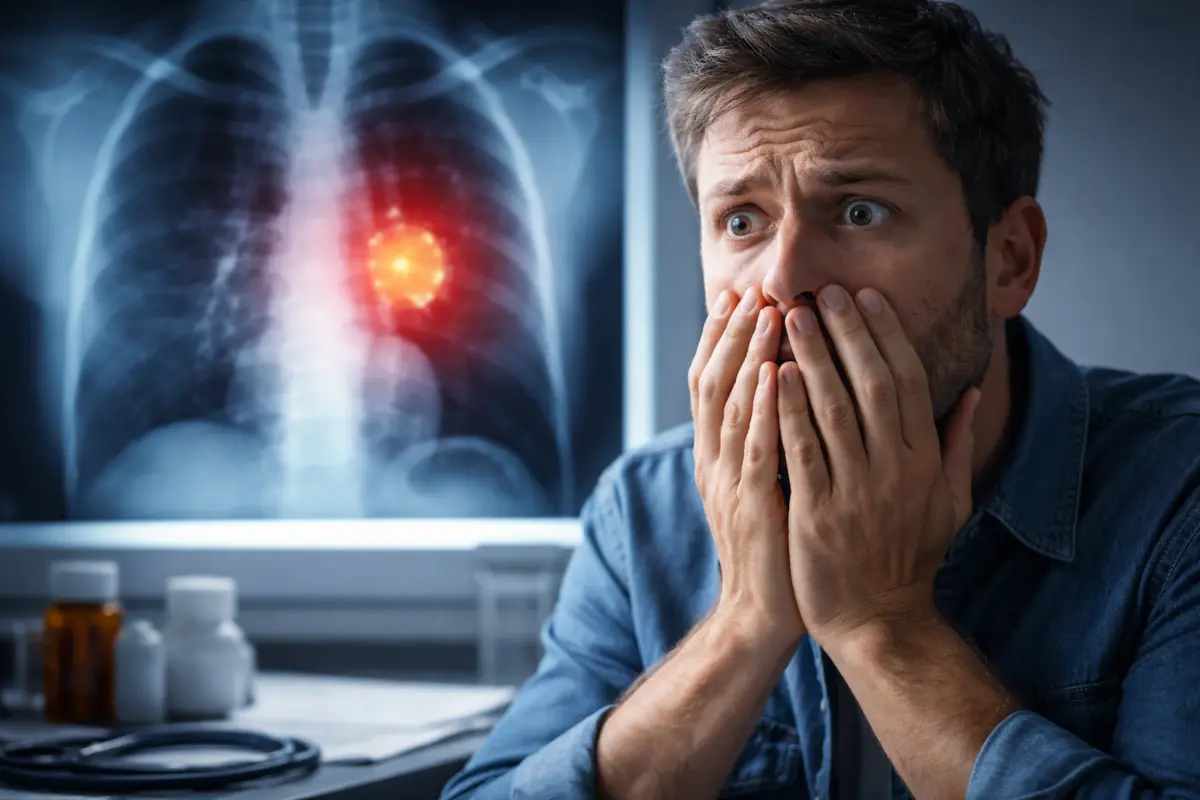
The Fear That Keeps You Sicker Than the Disease Itself
A growing body of research reveals that carcinophobia — the intense, irrational fear of cancer — silently stops millions from seeking the help that could save their lives. Here's what the latest science says.
M MindAlgo Research Team Clinical Psychology & Biometric Health April 2026 · 8 min readPicture this: Riya, a 34-year-old teacher from Kochi, noticed a small lump in her neck three months ago. She told herself it was a swollen gland. Then she told herself it was stress. Then she stopped telling herself anything at all — because thinking about it meant thinking about cancer, and thinking about cancer was something she simply couldn't bear. So she didn't go to the doctor. Not once.
Riya isn't rare. She's statistic.
According to a landmark 2025 systematic review and meta-analysis of over 90 studies, approximately 29% of people actively avoid seeking medical information about cancer — not out of ignorance, but out of fear. The very word triggers a shutdown in the nervous system that science is only now beginning to fully map.
73% of U.S. adults report anxiety when thinking about cancer screenings (Prevent Cancer Foundation, 2025) 40% of patients would avoid a doctor if they suspected a symptom might be cancer (Cleveland Clinic, 2024) 5+ yrs Cancer patients face elevated anxiety & depression risk for more than five years after diagnosis (LSHTM, 2024)What Is Cancer Fear, Really?
It has a clinical name: carcinophobia. It sits at the intersection of health anxiety, thanatophobia (fear of death), and what researchers now call the fear-avoidance spiral — a psychological loop where anxiety about cancer leads to avoidance of medical care, which leads to more anxiety, which leads to deeper avoidance.
For cancer survivors, the fear mutates into something equally debilitating: Fear of Cancer Recurrence (FCR). A 2024 study out of London School of Hygiene & Tropical Medicine confirmed that people diagnosed with cancer experience significantly elevated rates of anxiety and depression not just at diagnosis but for more than five full years after. It is not a phase. It is a chronic psychological condition that outlasts treatment itself.
"The fear of cancer is not always the fear of the disease. Often, it is the fear of what knowing would require you to do."
— National Cancer Institute Research Brief, 2024The Cruel Paradox: Fear as a Barrier to Survival
Here is what makes cancer fear uniquely dangerous: it is not neutral. Anxiety about cancer doesn't just cause suffering — it actively disrupts the behaviours that catch cancer early, when it is most treatable.
How Cancer Fear Shapes Behaviour (2025 Meta-Analysis, Oxford University Press)
Actively avoid information 29% Delay first symptoms visit 40% Behind on screenings despite worry 70% Report anxiety about screenings 73%This is the bitter irony the research keeps uncovering: people who are most worried about cancer are statistically more likely to miss the screenings that would detect it early. Anxiety becomes its own risk factor.
Scanxiety: When Even the Check-up Becomes Unbearable
Researchers at Regenstrief Institute in 2024 formalised a phenomenon that oncology nurses had observed informally for decades. They named it "scanxiety" — the intense spike of dread that builds up before and during medical imaging appointments such as MRIs, CT scans, and PET scans.
It is especially pronounced in cancer survivors on active surveillance — a monitoring protocol where patients are watched rather than immediately treated. The psychological cost of waiting is, for many, worse than the cost of treatment itself.
📋 Study SpotlightRare Cancer Patients: Three Times the Psychological Burden
A significant 2024 study published in ASCO Post found that patients diagnosed with rare cancers are nearly three times more likely to develop anxiety and depression compared to those with common cancers. Isolation, diagnostic delays, and limited peer support compound psychological distress in ways standard oncology care does not address.
Source: ASCO Post, 2024 — Rare Cancer Psychological Impact ReportWho Is Most Vulnerable?
Cancer fear does not strike equally. The latest research highlights several high-risk groups whose psychological needs remain critically underserved:
- Young adults (20–40): Face uniquely acute distress, with cancer interrupting education, fertility, career, and identity formation — often leading to higher emotional dysregulation than older patients.
- Childhood cancer survivors: Studies show that survivors continue to experience clinically significant FCR decades after their original diagnosis, yet receive almost no long-term psychological support beyond a 5-year mark.
- Family caregivers: 2025 data confirms caregivers carry comparable anxiety and grief loads to patients themselves — yet remain almost entirely outside the mental health care net.
- First-generation immigrants & low-income populations: Duke University research (2024) documented significant disparities in access to cancer-related mental health support based on race, income, and insurance status.
When Fear Masquerades as Calm
The most dangerous presentation of cancer fear is not panic. It's dissociation — the quiet, daily suppression of symptoms, the "I'll check it next month" that becomes years of avoidance. Physiologically, this kind of chronic suppressed anxiety creates a persistent low-grade stress response. The nervous system is activated, cortisol remains elevated, and the body pays a systemic price — silently.
Your Body Knows What Your Mind Avoids
Here is what the biology of cancer fear tells us: you cannot think your way out of an activated threat response. The amygdala — the brain's alarm system — cannot distinguish between a genuine cancer threat and the thought of cancer. Both trigger the same cascade: cortisol release, heart rate elevation, immune suppression.
The body registers the fear as real danger. And it responds accordingly. Minute by minute. Day by day. Year by year.
This is exactly why MindAlgo's approach starts with measurement, not interpretation. The most honest thing you can do with a fear you cannot see clearly is measure what it is already doing to your body. Not so you can be alarmed — but so that you can stop being ruled by what you cannot name.
"Anxiety thrives in ambiguity. When you can see your nervous system's response on a screen — its variability, its patterns, its baseline — the fear loses its formlessness. And formless fear is the most dangerous kind."
— MindAlgo Clinical Notes, 2025What the Science Says Actually Helps
The good news is that cancer fear is not untreatable. Major clinical bodies including ASCO (American Society of Clinical Oncology) now recommend formal psychological integration into oncology care — not as a supplement, but as a standard of treatment.
📋 Clinical Guidelines, 2024–2025Evidence-Based Interventions for Cancer-Related Anxiety
Cognitive Behavioural Therapy (CBT) remains the gold standard — consistently demonstrating reductions in anxiety and cancer-specific fear across populations.
Mindfulness-Based Interventions (MBIs) — particularly mindful movement and body-awareness practices — show strong evidence especially in breast cancer survivors and those on active surveillance.
Routine Psychological Screening in clinical settings — brief, standardised questionnaires — significantly improve early identification of patients who need support, before crisis sets in.
Biometric self-monitoring — emerging research supports the clinical value of real-time nervous system data in reducing health anxiety by grounding subjective fear in objective physiological information.
The Measurement That Changes Everything
Cancer fear is not weakness. It is a predictable, human, biological response to one of the most terrifying uncertainties a person can face. But left unexamined, unspoken, and unmeasured, it becomes a second illness running silently beneath the first.
The most important thing the research of 2024 and 2025 has made clear is this: the fear of cancer is a public health crisis as significant as cancer itself. It delays diagnosis. It disrupts treatment. It persists beyond remission. And it is almost entirely under-resourced.
If there is a lump, a symptom, a worry you've been quietly carrying — the answer is not to think more calmly about it. The answer is to measure what is happening inside you, bring that data to someone who can help, and refuse to let formless fear decide your fate.
Stop Managing the Fear. Start Measuring What's Underneath It.
MindAlgo uses rPPG biometric technology to give you real, objective data about your nervous system — so you can see what anxiety is actually doing to your body, not just feel it.
Measure My Nervous System →This article is for informational purposes only and does not constitute medical advice, diagnosis, or treatment. Always consult with a qualified healthcare provider for personal medical concerns.
Have questions about this topic? Our team is happy to help. Get in touch →